Buying craft well is less about memorising labels and more about learning where workmanship is visible. Handle printed textiles with mild cleaning, careful drying and realistic expectations about natural dyes and hand printing.
Begin with workmanship
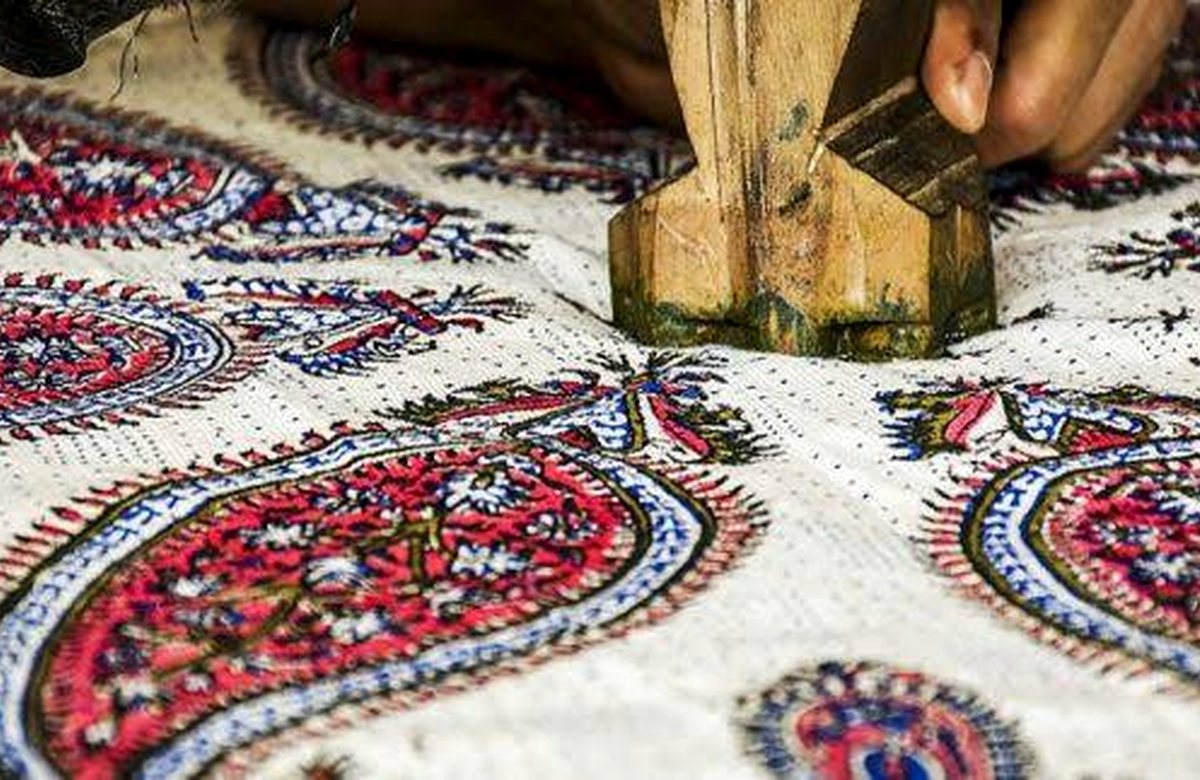
Qalamkar is associated with patterned cotton cloth produced through hand block printing and, historically, combinations of drawing, painting and printing. Carved blocks allow motifs to be repeated while still preserving small registration differences. A multi-colour design may require separate blocks or printing stages. Slight shifts can reveal hand registration, but large accidental gaps or muddy overlaps are different from intentional variation.
Seen this way, the object becomes more than a souvenir; it becomes evidence of a process, a material choice and a particular visual culture. If photographs are the only way to inspect a piece, ask for clear views of the front, back, edges and any area where different materials meet.
Look closely at condition
Because cloth folds and travels easily, qalamkar is one of the most practical Persian crafts for everyday interiors and international gifting. Persian tilework can be read as architecture and graphic design at once. Repeating units create large surfaces while calligraphy and vegetal ornament establish hierarchy.
That distinction matters because decorative complexity can hide poor finishing just as easily as it can reveal skill. If photographs are the only way to inspect a piece, ask for clear views of the front, back, edges and any area where different materials meet.
Ask better buying questions
Different periods and buildings use different techniques, including mosaic tile and painted multi-colour tiles; it is better to identify a method carefully than to treat all tile surfaces as the same craft. Textiles reveal craft through touch as much as sight. Fibre, weave, print, dye and finishing determine how a cloth hangs, ages and responds to use.
The strongest examples usually feel controlled rather than mechanically perfect: the eye can sense rhythm without losing the presence of the hand. If photographs are the only way to inspect a piece, ask for clear views of the front, back, edges and any area where different materials meet.
Protect the piece after purchase
Persian textile traditions include urban workshop production as well as village and nomadic practices, so one label cannot describe every object. The safest care principle is minimal intervention: dry dusting, soft cloths and stable indoor conditions are usually better than strong cleaners or frequent polishing.
It is also worth separating historical association from modern marketing. A living craft can be valuable without pretending every contemporary object is an unchanged survival from antiquity. If photographs are the only way to inspect a piece, ask for clear views of the front, back, edges and any area where different materials meet.
- Qalamkar is associated with patterned cotton cloth produced through hand block printing and, historically, combinations of drawing, painting and printing. Carved blocks allow motifs to be repeated while still preserving small registration differences.
- A multi-colour design may require separate blocks or printing stages. Slight shifts can reveal hand registration, but large accidental gaps or muddy overlaps are different from intentional variation.
- Because cloth folds and travels easily, qalamkar is one of the most practical Persian crafts for everyday interiors and international gifting.
Sources & further reading
- Victoria and Albert Museum — Caring for collections and decorative arts
- The Metropolitan Museum of Art — Heilbrunn Timeline
- UNESCO Intangible Cultural Heritage — Iran
This Journal is written as accessible editorial guidance, not as an attribution or authentication service. Dates, workshop practices and regional labels can vary by object.